Stylesheet

2012-02-14

Brother Printer Duplicity

Here's a good trick to increase your profit margins:

  1. Sell crap, but offer a warranty.
  2. When customers call in, don't replace the crap. Tell them how to "fix" it using procedures you know are inadequate.
  3. Keep telling them to not worry, and have faith that the inadequate procedures will work if followed properly and often enough.
  4. Repeat the previous two steps until the warranty period is over. Then tell them you can't do anything for them.

Here's my recent chat with Brother (complete with spelling/grammar errors) over one of my recent printer purchases that never worked quite right:

Chat Transcript

Time of chat: 2/14/2012 1:35:14 PM
Length of chat: 00:24:45
Your name: lugnut
Chatted with: Paul
   
1:35 PM Paul: Hello, lugnut. Thank You for contacting Brother Chat Support. Just a moment while I review your issue.
1:35 PM Paul: I understand that can be frustrating lets see what we can do to resolve this for you.
1:36 PM Paul: I have a solution I can send to you which will guide you through step by step instructions to help to resolve your issue. May send you the link with these instructions to you now?
1:36 PM lugnut: Yes, but I think I've seen it before. Go ahead and send the link, and I can tell you if I've already tried it.
1:36 PM Paul: http://host220.brother.com:8080/sap(bD1lbiZjPTAxMA==)/bc/bsp/sap/zsdb/display.htm?solution=200000029114
1:36 PM Paul: Please follow these steps to assist with your issue, was there anything else I can assist with today?
1:36 PM lugnut: Yes, there is.
1:37 PM lugnut: The link you sent describes the procedure I've already reviewed and tried.
1:37 PM Paul: The next step would be to replace the drum.
1:37 PM lugnut: The spots keep getting worse (i.e., there are more of them, and my efforts to clean them per the instructions no longer work).
1:38 PM lugnut: Also, there are parts of the drum which do not print ANY toner (i.e., they are blank spots, even where there should be printing). This has also degraded over time.
1:38 PM lugnut: How long are drums supposed to last with primarily B&W text printing?
1:39 PM Paul: The drum unit has a 90 day warranty. Drum unit: approx. 25,000 pages (1 page/job, A4/Letter size single-sided pages).
1:39 PM lugnut: By the way, the problem has ALWAYS been there (since my purchase). It's just gotten worse and worse all the time.
1:39 PM lugnut: Mine only has 12,000 pages. VERY light use.
1:40 PM lugnut: The problem has been present since I bought it. I've been able to limp by through the procedures you referenced, but they only really ever last 5 pages (max).
1:40 PM lugnut: Since the problem was present since the inception, is there any way you can send me a new drum? This one definitely seems defective.
1:40 PM Paul: When was the drum purchased?
1:40 PM lugnut: I don't remember exactly. It came with the printer. April of last year, maybe?
1:41 PM Paul: Unfortunately the drum is out of warranty at this time and will need to be replaced.
1:41 PM lugnut: The drum NEVER functioned properly.
1:41 PM lugnut: Even when it was within the warranty period.
1:41 PM Paul: Did you call in during that time?
1:41 PM lugnut: Like I said, I've been limping by at Brother's suggestions since that time, using the same cleaning method you mentioned.
1:42 PM lugnut: Yes, during my chats, everyone always told me to use the cleaning method.
1:42 PM lugnut: It would work for a few pages.
1:42 PM lugnut: Everyone kept telling me to keep at it.
1:44 PM Paul: Unfortunately the drum is out of warranty at this time and will need to be replaced.
1:45 PM lugnut: If I knew that, I would have asked for a replacement the FIRST time I chatted with you folks, when it WAS in warranty. YOU GUYS told me to keep trying this.
1:46 PM Paul: Those are the steps to clean the drum. There is nothing at this time that can be done lugnut. The drum will need to be replaced to clear the print quality issue.
1:48 PM lugnut: Okay, fine. But for the past several times, INCLUDING WHEN IT WAS INSIDE THE WARRANTY, YOU GUYS dismissed me and told me to go clean it. That was it. I kept information whomever I chatted with that this was the 2nd, 3rd, etc. time, but I always received the same story. I RELIED ON YOUR ASSURANCES THAT WOULD ADDRESS THE PROBLEM. Now you're telling me that BECAUSE I followed your instructions, I now have to bear the cost. Is that right?
1:49 PM Paul: Did you ever call for this issue?
1:49 PM lugnut: I always did the live chat thingy. I might have called, I don't remember.
1:50 PM lugnut: It's been a long, very frustrating time.
1:50 PM Paul: What is the phone number you provided when you called?
1:51 PM lugnut: I don't remember. It was a long time ago. Maybe XXXXXXXXXX or XXXXXXXXXX, but I don't remember. It could have been something else.
1:52 PM lugnut: I typically do not give out my phone number because companies sell it to everyone under the sun. I typically make up a number and give that one.
1:52 PM lugnut: I don't write them down.
1:52 PM lugnut: I value my privacy.
1:53 PM lugnut: To be honest, I don't even remember being asked for one. It could have happened, I just don't know.
1:53 PM Paul: Unfortunately there is no recorded of you calling. Chat started in August if you purchased in April the drum would have been out of warranty.
1:53 PM lugnut: All I know, is that you guys kept telling me to go away and clean it. Just like you attempted at the beginning of this chat.
1:53 PM lugnut: Same deal.
1:53 PM Paul: We ask for the phone number at the begging of every call for issues such as this.
1:53 PM lugnut: Again, I make them up.
1:53 PM lugnut: For privacy reasons.
1:54 PM lugnut: I don't give out my phone number.
1:54 PM lugnut: I don't remember the number I gave.
1:54 PM Paul: Unfortunately at this time lugnut there is nothing that I can do for you the drum will need to be replaced. Is there anything else I can assist you with?
1:55 PM lugnut: So let me get this straight just so I understand.
1:55 PM lugnut: I follow your instructions.
1:55 PM lugnut: As a result, I find myself outside the warranty period.
1:56 PM lugnut: You refuse to accommodate me, so I have to pick up the bill for a product that never worked right.
1:56 PM lugnut: Is that right?
1:56 PM Paul: The last step in the instructions show to call in if the issue continues
1:56 PM lugnut: WHICH I DID.
1:56 PM lugnut: YOU GUYS KEPT TELLING ME TO CLEAN IT.
1:56 PM lugnut: IT WORKED.
1:56 PM lugnut: BUT ONLY FOR A FEW PAGES.
1:56 PM lugnut: ARE YOU EVEN LISTENING TO ME?
1:56 PM Paul: You would have been escalated to the next level. Chat cannot do this.
1:56 PM lugnut: NOW YOU TELL ME.
1:57 PM Paul: If you called we would have a record.
1:57 PM Paul: The solution says to call in not chat in lugnut.
1:58 PM lugnut: Really?
1:58 PM Paul: - If the dots or marks still appear, please call Brother Customer Service by calling 1-877-Brother (1-877-276-8437) Monday through Friday, excluding holidays.
1:58 PM lugnut: That's what you're going with?
1:58 PM Paul: That is why it appears in the solution.
1:58 PM lugnut: I have to pick up the tab because the communication mechanism brother advertises aren't equal?
1:59 PM lugnut: Seriously?
1:59 PM lugnut: This is what you're going with?
1:59 PM Paul: lugnut at this time the Drum will need to be replaced. The drum is out of the 90 day warranty. Thank you for contacting Brother.
1:59 PM lugnut: I've been a loyal brother customer for 15 years.
1:59 PM Notice: Paul exited session.

2011-12-22

I helped make egomaniacal dickhead James Dyson rich, and all I got was this lousy plastic vacuum cleaner (a review of the Dyson DC25)

It sucks, and boy does it suck. But that’s about all the Dyson DC25 we bought ourselves for Christmas does well. With an MSRP of $549, I anticipated a sturdier design with more modern features. What we got was a glitzy, plastic temple built in homage to the false idol of James Dyson’s self-proclaimed design genius.

First impressions

When one unpacks a Dyson vacuum, one’s dopamine re-uptake is halted almost immediately as one is confronted with the fact that one just spent hundreds of dollars on what appears to be a clunky, poor-fitting, mass-produced, over-priced piece of plastic junk. It rattles. It wobbles. Nothing fits quite right, and moving parts continue to move within lax tolerances even when in “fixed” positions. While I don’t doubt hundreds of thousands of dollars went into designing this thing (and probably 100 times that into marketing it), a fine piece of quality engineering it is not.

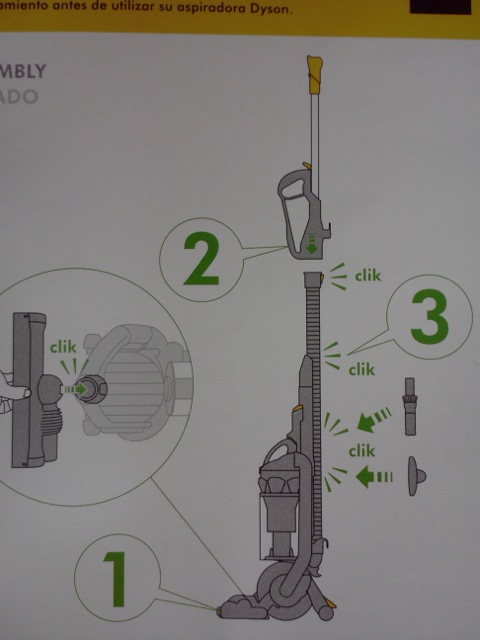
Dyson installation instructions w/ missing letters
Ooo! Edgy, emo marketing! It says, “We cnt b bthrd 2 spel. We’re 2 impotent. Fck u!” Apparently, so much money was spent developing this product, the company had to ration “Cs” when spelling “click” in order to save on ink.

Thankfully, assembly was minimal, and we were quick to get to a real test.

Yup, it sucks

We purchased the DC25 to replace our $150 Hoover WindTunnel Upright which had faithfully failed two months outside of its warranty period. (Thank you, Hoover.) We immediately noticed that suction and dirt collection for the DC25 was somewhat superior when used in the traditional manner. We also noticed some other things.

The "vacuum that doesn't lose suction" loses suction
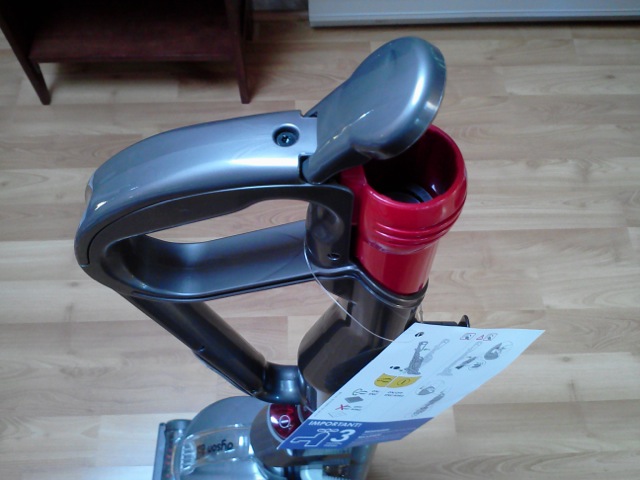
Be careful not to let the handle brush by your hip on the forward stroke. You could displace this cap causing the "vacuum that doesn't lose suction" to lose suction.

Ingenious idea #227: create a cool, new “feature,” then design the rest of the product so that feature is really hard to use

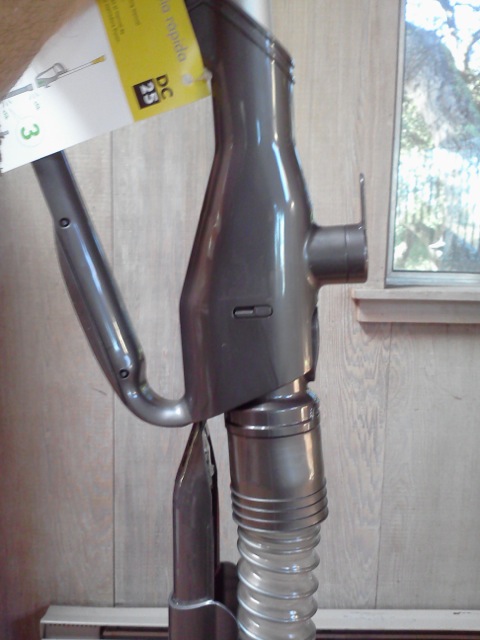
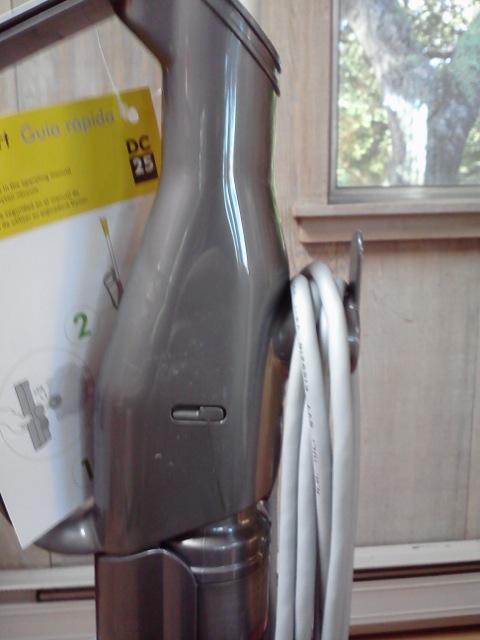
The handle of the vacuum doubles as the handle of the wand. Neat, right? No need to waste a whole other handle if one can avoid it, I always say. That is until one realizes that the cord catch is built into the removable handle. Yup, you read that right: in order to use the wand, you have to unwind the entire length of the cord, then wind it back when you’re done.

Dyson removable handle Dyson removable handle trapped by wrapping fixed cord around it
Brilliance abounds! Make the fixed part wrap around the part that is supposed to be removable making the removable part fixed too!

While we’re on the subject of cords, our aforementioned sub-$200 Hoover had a retractable cord. Electrolux and Miele make vacuums with retractable cords. Even Eureka, Bissell and LG make vacuums with retractable cords. (LG for goodness sakes! I didn’t even know they made vacuums!) For a $500+ vacuum from the self-appointed industry “leader” in design, I would expect some kind of mechanism for cord handling beyond what existed in the late 1800s.

Shortly after using the wand, we found that “extra” handle wasn’t so superfluous after all. While cleaning the rafters, we went to go pick up the vacuum so we could move concurrent with our wand wielding. Guess what we found? No handle.

Dyson unnecessarily eliminates necessary handle
Let’s move! Wait, how am I supposed to pick that thing up again now that the handle’s in my hand?

To be fair, Dyson has a drawing on its website depicting how a similar vacuum might be carried. Let me assure you that given the construction of this vacuum, I would not feel comfortable carrying the DC25 this way. It puts stress and strain on unnecessarily delicate parts and seems to be begging for premature breakage.

An unnecessarily small and complex canister designed to break

Dyson makes a big deal highlighting its “push button bin-emptying” (it even has a video on its website). It basically has integrated an impossibly flimsy plastic mechanism to migrate the button to open the canister from its bottom to its top. Thanks, but I prefer simplicity over masturbatory displays of gratuitously complex solutions which most likely just introduce additional points of failure. I’d trade this in a heartbeat for a retractable cord or a fixed handle (see above).

Dyson’s delicate canister
Recipe for disaster: that thin red plastic piece snaking its way around the canister is all that separates it from a worthless piece of junk.

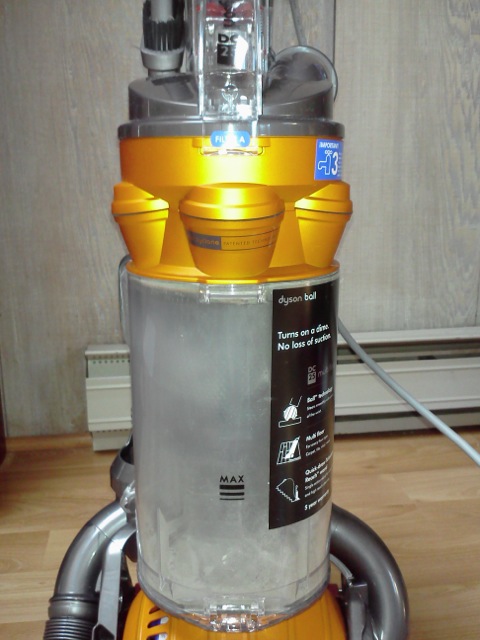
Additionally, Dyson’s canister is fairly small compared with other brands. Not only that, but one can only fill it up about ⅓ of the way before it’s full. That means less time vacuuming and more time trying to break pushing that flimsy bin-empty button.

Dyson’s unusually small
This is probably an artifact of Dyson’s “Root Cyclone” design, but that is not much space if one has a lot of material to pick up.

The ball: a solution in search of a problem

The literature that accompanies the DC25 boasts that its ball allows it to “pivot[] on a single point, allowing it to go in any direction,” claiming superiority over those nasty “fixed axle” vacuums. First, I’m not aware of any modern vacuums that use fixed axles, much less two as depicted. So yes, the Dyson ball is superior to the lawnmower-like vacuums from the distant world of Strawmania, but not those found modernly here on Earth.

Dyson promotional bullshit
Last time I checked, carbon “emissions” from brush wear on a traditional electric motor were negligible, but using fear and ignorance to promote one’s crap is all the rage nowadays!

Second, after actually using the ball, I can say quite certainly it definitely does not “turn on the spot” as claimed. Its pivoting capabilities may be marginally better than a eunuch version, but the difference is barely perceptible. What’s actually worse about the ball is that the Dyson has a very difficult time traveling in a straight line. It’s kind of like vacuuming drunk, but without the nudity and emergency vet bills.

Dyson says “no” to cleaning in tight spots

Forget about vacuuming the hardwood floor under your couch or bed. Dyson does not provide a solution. The DC25 has too high a profile (even in its lowest position), and its attachments are ill-suited for the job. They’re also ill-suited for getting into narrow gaps and anything requiring a brush larger than the size of two quarters.

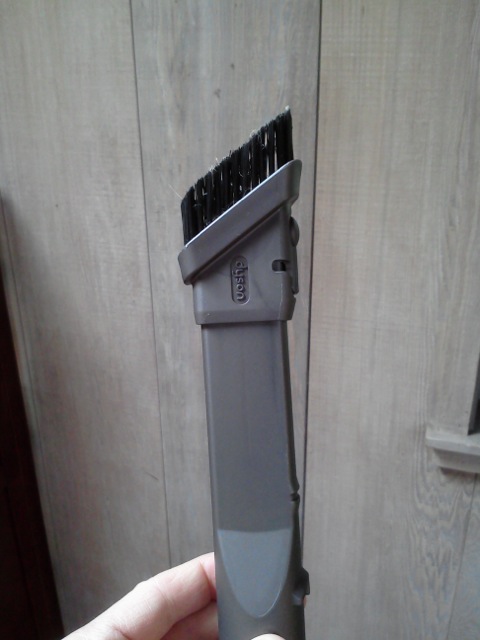
Dyson’s useless attachments Dyson’s useless attachments
Hey! That two-in-one attachment is pretty cute! It’s also totally useless for vacuuming any narrow gap deeper than two inches. The brush is just an annoyance. It’s too small to serve any real purpose.

That’s okay though. We can buy other manufacturer’s attachments to fill in the gaps in Dyson’s product line, right? Wrong. Which brings us to....

Vendor lock-in...on a vacuum cleaner? Srsly?!

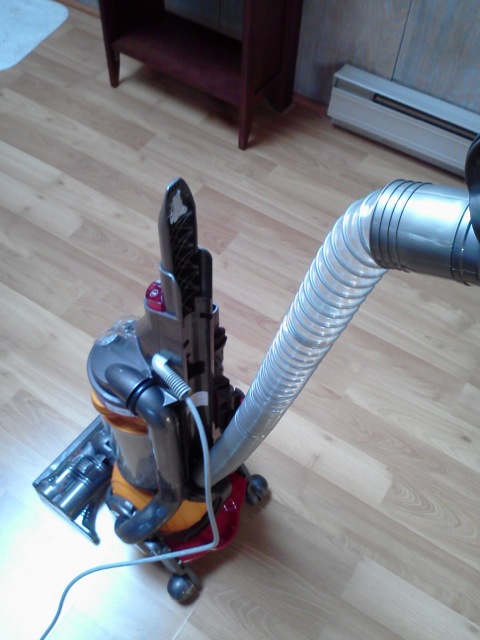
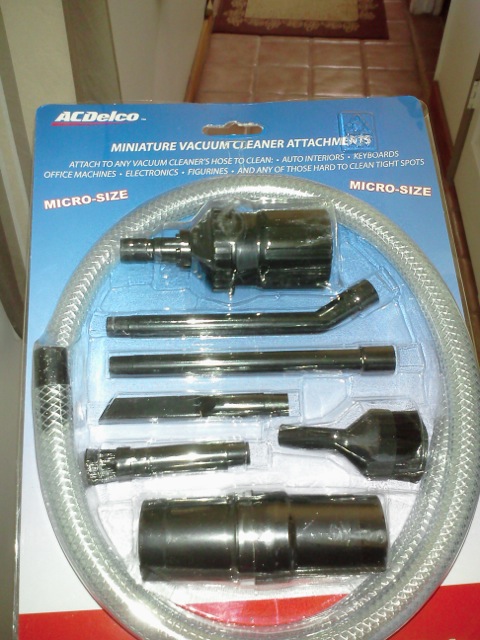
For as far back as I can remember, vacuum hoses came in two standard sizes: 1¼-inch and 2-inch. Everybody’s fittings worked with everybody else’s fittings because they all used the same conventions. One of the “innovations” popularized by Microsoft in the software industry is something pejoratively referred to as “vendor lock-in.” Loosely defined, it means that once you purchase one product, you’re commited to buying all related products from the same manufacturer, because they’ve purposely design them so that nothing else can work. Dyson has brought this great frustration advancement to the vacuuming world, flying it under the false flag of “simplified design” (as if we didn’t have enough to worry about figuring out how we were going to vacuum under the couch).

Dyson proprietary vacuum attachments Vacuum attachments useable in 99.999% of all vacuums (but not the Dyson)
One of these kids is not like the other. You can toss all of your existing 1¼" attachments out—they’re useless with the Dyson.

Dyson vacuums use proprietary connections for all attachments. Now before you go foolishly hoping that other attachments may work by jamming them into the same holes, think again. They won’t. What’s even more frustrating is that Dyson sells a “universal fit adapter,” but only in the UK. If you live Stateside, you’re out of luck.

Dyson says “yes” to promotional propaganda

Accompanying the vacuum is an Apple-style pamphlet telling you how great James Dyson is and how lucky you are to have spent hundreds of dollars on his ill-conceived products. It’s insulting and smacks of narcissism.

More Dyson promotional bullshit
James Dyson: obsessed with balls. Apparently ¾ of his worthwhile early designs involved taking normal things and slapping one or more balls on them. The DC25 is no different.

Final thoughts

After fifteen minutes of use, it became painfully obvious to us that no one at Dyson had bothered to test this product in an actual cleaning scenario or compare it to competing products. If they did, they would have quickly discovered the above shortcomings and perhaps corrected them.

Even more Dyson promotional bullshit
With over 5,100 iterations, one would think someone would have field tested this product. But I guess it’s easier to spend millions of dollars marketing a gimmick than meaningfully address issues with actual use.

The vacuum is functional. It sucks well. With some minimal bargain hunting, you can probably find the DC25 (or newer iterations) for around $350. But even then, it lacks the type of quality and attention to detail that should be present at that price. When you purchase a Dyson vacuum, you’re effectively paying a hefty premium to be a beta tester for a very slow learner who is apparently obsessed with balls.

But hey, that’s just one guy’s opinion....

2010-05-24

Pssst! Pass it on!

I wrote this piece on antisocial motorcycle riding after finding a particularly compelling Australian public service announcement on YouTube. This could have just as easily been posted here, so I thought I’d share. Please share it with your fellow riders.

2010-05-09

Facebook teaches us how destroy trust and alienate customers

A while back, I wrote a rather long-winded piece on brand trust. I recently had an opportunity to reflect on that material when I couldn’t log into Facebook for an extended period of time. While I don’t spend hours and hours on the site, I do rely on it to stay connected with some people. With me, as with many users, Facebook is the sole means of contact between me and some of my peers (former coworkers, former classmates, etc.). I’m sure this is music to the ears of many Facebook executives, but my recent experience has left me feeling a little uneasy about the situation.

“One of the quickest ways to permanently destroy [users’] trust is to make [them] feel helpless: 1) deny them access to their critical data; 2) without warning or notice of why or for how long; and 3) make it impossible for them to find out.”

I should mention that I have spent about a decade in software development. I have worked on distributed systems involving millions of transactions per day for companies like Amazon.com and Yahoo! So I understand some of the complexities involved in implementing a platform like Facebook that can scale to hundreds of millions of users.

When I attempted to log into my Facebook account around noon on a Saturday, I was surprised by the message, “Your account is temporarily unavailable due to site maintenance. It should be available again within a few hours. We apologize for the inconvenience.”

As someone who has been around large scale systems for most of my career, I know it is extremely rare that scheduled or anticipated maintenance occurs during peak hours. However, I also know that well-implemented systems temporarily forbid access to parts of an application which experience unanticipated critical failures (e.g., widespread network or power outage, widespread data corruption, etc.). I know that reliably supporting millions of transactions per day is hard. Shit happens. Nascent applications (like Facebook) are bound to run into difficulties at some point. I’m certainly not going to bash Facebook engineers if it happens on their watch (glass houses and all).

But this instance doesn’t sit well with me for a few reasons. First, the outage ended up being quite long. It wasn’t until over a day later that I was able to log in again. Second, during the entire outage I had zero information on the nature of the problem and the estimated resolution time. These alone may be tolerable, but after Googling the issue, I found out I wasn’t alone. People have been experiencing issues like this for several years. Third, there is absolutely no way to gain more visibility. Facebook does not provide a means to contact it if this problem arises. This is probably for good reason in most cases (one doesn’t want several thousand affected users calling or e-mailing every time they forget their password), but it is very frustrating if you are among those who have been locked out for several weeks. While Facebook acknowledges the issue, it requires that you log in to alert them to a prolonged lock-out.

Yes, that’s right: if you can’t log in, then you must log in to let them know you can’t log in. I’m curious how many of Facebook’s 300+ million accounts were created just to log in to complain that the primary account was unavailable....

When one places critical data into the hands of another to manage, it requires a lot of trust. Most often, this trust is built up over a long time. Little by little, through repeated use, users trust Facebook to deliver access to the social circles they have created. Some, like me, end up trusting it so much that it becomes their exclusive means. One of the quickest ways to permanently destroy that trust is to make your users feel helpless: 1) deny them access to their critical data; 2) without warning or notice of why or for how long; and 3) make it impossible for them to find out.

Facebook FAIL

You can be sure I am thinking twice about finding an alternative. This will likely mean that I spend less time on Facebook in the future, which will mean less exposure to the site’s ads, which will result in fewer clicks, which will mean less in advertising revenues. Don’t get me wrong, I am not so narcissistic as to think my reduction in use alone can affect Facebook’s bottom line, but if the company isn’t careful, on aggregate users whose trust has been breached can have a real effect. This might open the door for a competitor like Google to step in. Hopefully Facebook can work out its issues before this happens.

But hey, that’s just one guy’s opinion....

2010-04-20

Time to stop wasting oil

Reducing my oil footprint has become of increasing importance to me as I’ve gotten older. One way that I’ve done that is to switch to long drain interval synthetics for all of my vehicles. Yes, I know that when compared to fuel use, engine oil makes up a relatively small percentage of oil consumption. But when you consider that 118 million oil changes are performed annually in the US alone (50-70% of which are probably unnecessary), the numbers start to add up.

I’m a little bit greener for having switched. What about you? Are you wasting oil?

2010-02-21

Bullshitting me is not an effective way to build trust in your brand

One of the core tenets of brand marketing is trust. Some branding experts refer to “building trust.” I don’t like that phrase. I prefer brands that “earn” trust to those that “build” it. Nevertheless, oodles of experts have written on the topic.
“Any brand, no matter how memorable, will fail to achieve its goals if it does not gain the public’s trust. Given the skeptical nature of the public today, this is exceedingly difficult to come by.” (Brock Ray, “Building Trust Into Your Brand,” Oct 07 2009.)
Why is it then, that most advertising today seems desperate or manipulative?
“‘[T]elling the truth—authenticity—is one more requirement of effective branding....’ 75% of the American people don’t trust advertising or advertisers.” (Charles H. Green, “Is ‘Brand Trust’ An Oxymoron?,” May 09 2008.)
I suspect it is a result of dysfunctional organization, lack of corporate leadership or both. Often times, especially in large corporations (or at least in corporations with large marketing budgets), there is a tension between maintaining the integrity of a brand, and showing short-term positive results. While, I appreciate the temptation to mortgage the future to pay for the present is nothing new, I am suggesting that succumbing to that temptation is harmful. I have some advice to corporate leaders everywhere to attempt to resolve this tension and strengthen brands (and companies) in the process.

Do what you say you’d do

Reliability is one of the single most effective ways of eliciting trust. Necessary corollaries are, “Don’t promise what you can can’t deliver,” and, “When you screw up, take responsibility.” This may seem obvious, but one wouldn’t know that by examining modern corporate and social behaviors. We are constantly perpetuating half-truths designed to avoid confrontation and judgment. This happens in most of our relationships with the companies we patronize, the politicians we elect, even our friends and loved ones.

What most people fail to acknowledge is that eventually most of those half-truths are exposed, and they detract from the trust we have in those relationships. If someone promises to perform and fails two or three times, we learn that person is unreliable. If we find that someone misleads to avoid embarrassment, controversy or responsibility, we learn to expect that person’s statements to be self-serving and dishonest.

Thankfully there is a way to correct this behavior in your organization: make your mission simple and specific; make your mission part of your culture and make your brand synonymous with your mission; and identify and resolve competing interests.

Make the corporate mission simple and specific

A long time ago, in a marketing guru seminar far, far away, someone decided that a corporate mission statement should be a single, run-on sentence that is sufficiently vague so as to avoid accountability. I am calling for an end to that practice.

Yahoo!’s most recent mission statement reads: “Yahoo! powers and delights our communities of users, advertisers, and publishers - all of us united in creating indispensable experiences, and fueled by trust.”

Besides being grammatically awkward, I don’t get a clear sense of what it is that Yahoo! is trying to accomplish. If I were to attempt to rewrite it, I might suggest the following:
Yahoo!’s mission is to:
  1. provide users with the most compelling content and most useful applications for their daily lives;
  2. provide publishers the best way to reach their audiences; and
  3. provide advertisers the most effective way to market their products and services.
Making the mission simple and specific is a way of making it understandable. This is key. Members of your organization cannot do what the company says it’s going to do if they don’t understand what was said in the first place.

Make the corporate mission part of the culture and make the brand synonymous with the mission

Making the mission a top priority for everyone is a lot harder than it sounds. It requires that everyone in the organization has some short-term periodic (e.g., daily or at-most weekly) gut-check about how their recent efforts further corporate goals.

Lazy managers rely exclusively on shortcuts like integrating certain phrases into call-center scripts (e.g., “How can I provide you with excellent service today?”) or distributing vision statements printed on company t-shirts, coffee mugs or squeeze toys. I’m not saying these things aren’t valuable, but they are insufficient on their own.

Good leaders will find effective ways to keep the corporate mission in their employees’ sights. This could be as simple as a weekly priorities meeting where the host holds up the company logo and mission statement and earnestly asks, “How do you think we helped or hindered this image last week?” Where appropriate, a good follow-up might be, “How would our customers agree or disagree with your assessment?” To be effective, these interactions have to be free from judgment or reprisal.

Identify and remove competing interests

In law school, one of my professors taught me that good legal writing goes beyond motions and briefs. Every memo, every e-mail, every communication is an opportunity to either strengthen or damage one’s reputation as an attorney.

This is particularly good advice for corporate content providers like public relations managers, advertising agents, copy writers, etc. They have to keep in mind at all times when designing content, it should not only accomplish short-term goals (e.g, reduce service calls, increase registrations, etc.), but shouldn’t harm the brand.

If there is a division in your company that is detracting from your brand, find out why. It may be lack of leadership (in which case the company mission isn’t part of that division’s culture), or it may be that there are competing priorities. If it is the latter, then one has to identify the conflict and determine if the cost to the brand is worth the return.

Fraud and theft prevention is an frequent area of tension. On the one hand, legitimate customers tend not to like to be treated as criminals. However, thieves often take advantage of this in order to disguise their thefts. This may be an area where mistakenly treating a few legitimate customers as suspects may be acceptable to avoid significant loss. But a company should not try to disguise this trade-off (see below).

Advertising is another frequent area of tension. If an advertising agent’s income is directly tied to short-term performance of specific advertising campaigns, then maintaining brand integrity will take second seat. Compensation methods may need to be reevaluated to achieve the appropriate priorities.

Some simple examples

Here are some common examples of how to erode consumers’ trust in your brand:
Example 1: dishonestly portraying a limitation as intended
This is one of my pet peeves whenever I call a bank. Often times, I speak to a general representative who asks me for my account number and some verifying information, and then that person transfers me to a specialist who asks me for similar information. When I indicate I’ve already given it, I’m often told that I have to give it again for security purposes.

This is infuriating. It suggests I’m too stupid to detect the lie. I would much rather hear, “I know, but unfortunately our system doesn’t transfer that information along with your call, so I need to ask you for it again.” Being honest in this scenario does two things. First it is instantly disarming, and actually builds trust by openly acknowledging the limitation. Second it keeps the representative out of an adversarial role as a conspirator in a lie.
Example 2: disguising advertising as something else
Product placement in the entertainment industry is a notorious example of this. Frequently-asked questions (FAQs) are a less obvious, but common target of abuse.
“Many FAQs pages don’t actually respond to frequently asked questions; instead, responses relate to questions businesses expect their customers to ask — or worse, simply answer questions they want customers to ask.” (Rick Allen, “FAQs Pages: Good Web Usability or Outdated Content Strategy?,” Aug 17 2009.)
Even some of the best-loved companies make this mistake. After years of complaints from a very vocal user base, Apple decided to remove the copy protection (DRM) from music sold through iTunes. Yet on its FAQ page, it listed the question, “Can I still buy music encoded at [an inferior bit rate] with Digital Rights Management (DRM)?”

I’m not sure what Apple was trying to accomplish with this question, but it seems like it would have been much better to answer, “Will any media available via iTunes be restricted?” or, “How can I tell if what I purchase on iTunes is restricted?”

Don’t attempt to mislead your consumers by disguising advertising as “help” or “important information.”
Example 3: spinning hostile behavior as advantageous
There are no shortage of examples of this behavior, but one ubiquitous abuse often occurs in “privacy” policies. These contain information which should educate a consumer how and when a company shares that consumer’s personal contact information, purchasing habits, etc. However, they are often designed specifically to mislead and confuse. For example, companies often use a heading similar to, “how [Company] protects your information,” before a paragraph with very small text describing how they do the exact opposite.

Anti-theft measures also frequently fall under this category. Consumer electronics stores, retailers, and even respected companies like Costco have receipt checks for people exiting their stores. Consumers are often told these checks are for their own protection (i.e., to make sure they have everything they paid for). They are not. They are designed to prevent theft, and have the unfortunate side-effect of treating each customer as a suspect.

Stores have a right to try to prevent theft. Companies can try to make money in a myriad of ways. But by misleading consumers about their reasons, they erode the trust those consumers have in the company. If a company is willing to lie about why it requires receipt checks, it may be willing to lie about quite a bit more.

Conclusion

If your brand is not important to you, or if your company mission is something like, “to provide as little value as possible for the most profit,” this article won’t be relevant for you. But if brand integrity is as important as marketing experts have claimed for decades, the above will help give it the priority it deserves. Incorporating it into your organization won’t be easy, but I suggest that if you are successful, the power of your brand—and your company—may very well become immeasurable.

But hey, that’s just one guy’s opinion....