It sucks, and boy does it suck. But that’s about all the Dyson DC25 we bought ourselves for Christmas does well. With an MSRP of $549, I anticipated a sturdier design with more modern features. What we got was a glitzy, plastic temple built in homage to the false idol of James Dyson’s self-proclaimed design genius.
First impressions
When one unpacks a Dyson vacuum, one’s dopamine re-uptake is halted almost immediately as one is confronted with the fact that one just spent hundreds of dollars on what appears to be a clunky, poor-fitting, mass-produced, over-priced piece of plastic junk. It rattles. It wobbles. Nothing fits quite right, and moving parts continue to move within lax tolerances even when in “fixed” positions. While I don’t doubt hundreds of thousands of dollars went into designing this thing (and probably 100 times that into marketing it), a fine piece of quality engineering it is not.
Ooo! Edgy, emo marketing! It says, “We cnt b bthrd 2 spel. We’re 2 impotent. Fck u!” Apparently, so much money was spent developing this product, the company had to ration “Cs” when spelling “click” in order to save on ink.
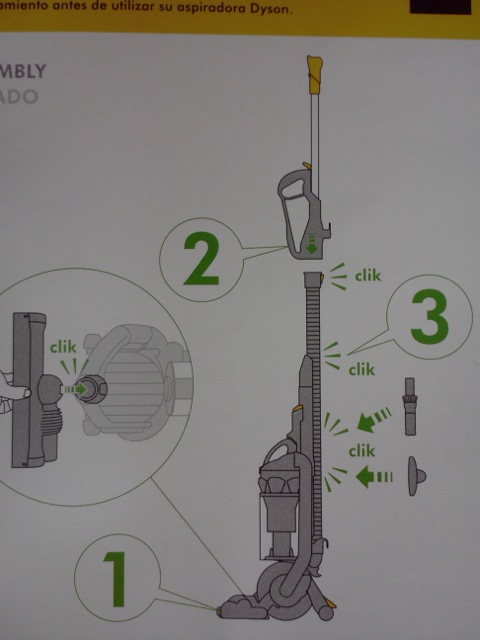
Thankfully, assembly was minimal, and we were quick to get to a real test.
Yup, it sucks
We purchased the DC25 to replace our $150 Hoover WindTunnel Upright which had faithfully failed two months outside of its warranty period. (Thank you, Hoover.) We immediately noticed that suction and dirt collection for the DC25 was somewhat superior when used in the traditional manner. We also noticed some other things.
Be careful not to let the handle brush by your hip on the forward stroke. You could displace this cap causing the "vacuum that doesn't lose suction" to lose suction.
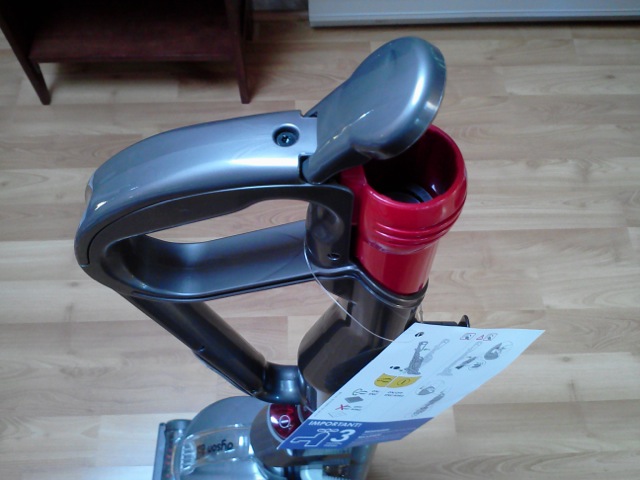
Ingenious idea #227: create a cool, new “feature,” then design the rest of the product so that feature is really hard to use
The handle of the vacuum doubles as the handle of the wand. Neat, right? No need to waste a whole other handle if one can avoid it, I always say. That is until one realizes that the cord catch is built into the removable handle. Yup, you read that right: in order to use the wand, you have to unwind the entire length of the cord, then wind it back when you’re done.
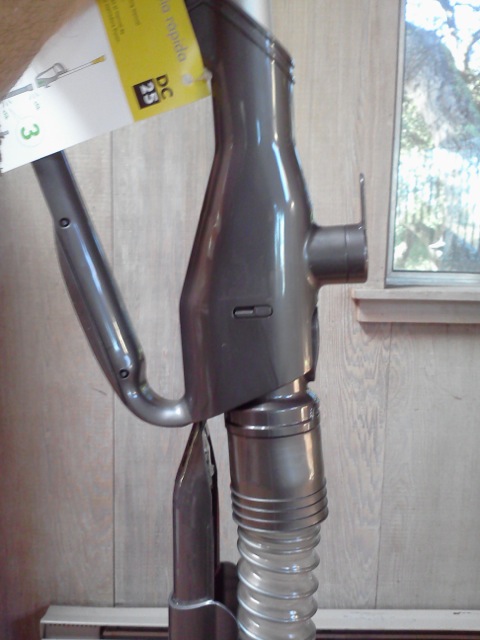
Brilliance abounds! Make the fixed part wrap around the part that is supposed to be removable making the removable part fixed too!
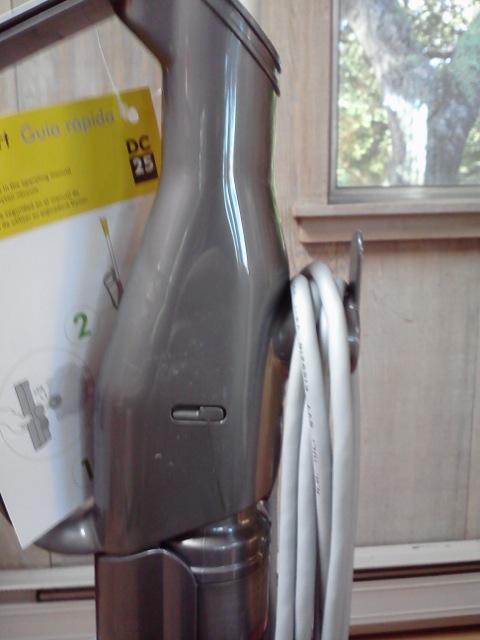
While we’re on the subject of cords, our aforementioned sub-$200 Hoover had a retractable cord. Electrolux and Miele make vacuums with retractable cords. Even Eureka, Bissell and LG make vacuums with retractable cords. (LG for goodness sakes! I didn’t even know they made vacuums!) For a $500+ vacuum from the self-appointed industry “leader” in design, I would expect some kind of mechanism for cord handling beyond what existed in the late 1800s.
Shortly after using the wand, we found that “extra” handle wasn’t so superfluous after all. While cleaning the rafters, we went to go pick up the vacuum so we could move concurrent with our wand wielding. Guess what we found? No handle.
Let’s move! Wait, how am I supposed to pick that thing up again now that the handle’s in my hand?
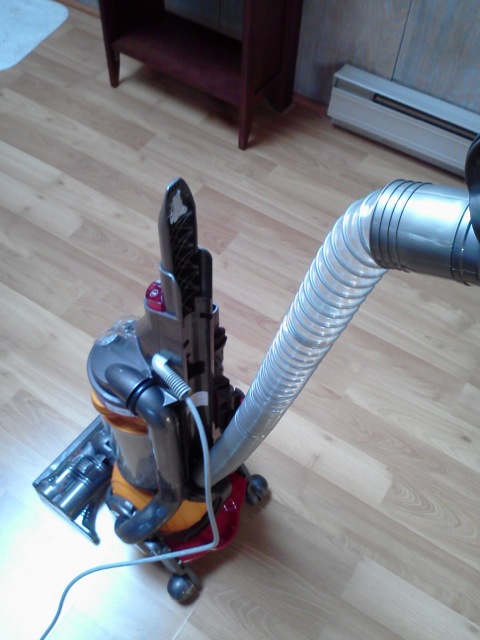
To be fair, Dyson has a drawing on its website depicting how a similar vacuum might be carried. Let me assure you that given the construction of this vacuum, I would not feel comfortable carrying the DC25 this way. It puts stress and strain on unnecessarily delicate parts and seems to be begging for premature breakage.
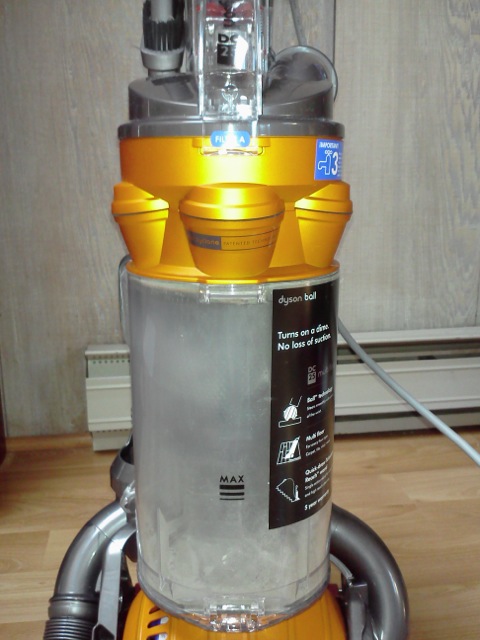
An unnecessarily small and complex canister designed to break
Dyson makes a big deal highlighting its “push button bin-emptying” (it even has a video on its website). It basically has integrated an impossibly flimsy plastic mechanism to migrate the button to open the canister from its bottom to its top. Thanks, but I prefer simplicity over masturbatory displays of gratuitously complex solutions which most likely just introduce additional points of failure. I’d trade this in a heartbeat for a retractable cord or a fixed handle (see above).
Recipe for disaster: that thin red plastic piece snaking its way around the canister is all that separates it from a worthless piece of junk.

Additionally, Dyson’s canister is fairly small compared with other brands. Not only that, but one can only fill it up about ⅓ of the way before it’s full. That means less time vacuuming and more time trying to break pushing that flimsy bin-empty button.
This is probably an artifact of Dyson’s “Root Cyclone” design, but that is not much space if one has a lot of material to pick up.
The ball: a solution in search of a problem
The literature that accompanies the DC25 boasts that its ball allows it to “pivot[] on a single point, allowing it to go in any direction,” claiming superiority over those nasty “fixed axle” vacuums. First, I’m not aware of any modern vacuums that use fixed axles, much less two as depicted. So yes, the Dyson ball is superior to the lawnmower-like vacuums from the distant world of Strawmania, but not those found modernly here on Earth.
Last time I checked, carbon “emissions” from brush wear on a traditional electric motor were negligible, but using fear and ignorance to promote one’s crap is all the rage nowadays!
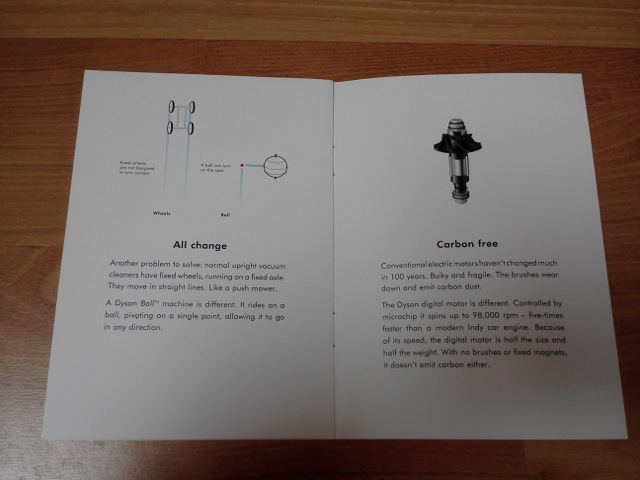
Second, after actually using the ball, I can say quite certainly it definitely does not “turn on the spot” as claimed. Its pivoting capabilities may be marginally better than a eunuch version, but the difference is barely perceptible. What’s actually worse about the ball is that the Dyson has a very difficult time traveling in a straight line. It’s kind of like vacuuming drunk, but without the nudity and emergency vet bills.
Dyson says “no” to cleaning in tight spots
Forget about vacuuming the hardwood floor under your couch or bed. Dyson does not provide a solution. The DC25 has too high a profile (even in its lowest position), and its attachments are ill-suited for the job. They’re also ill-suited for getting into narrow gaps and anything requiring a brush larger than the size of two quarters.

Hey! That two-in-one attachment is pretty cute! It’s also totally useless for vacuuming any narrow gap deeper than two inches. The brush is just an annoyance. It’s too small to serve any real purpose.

That’s okay though. We can buy other manufacturer’s attachments to fill in the gaps in Dyson’s product line, right? Wrong. Which brings us to....
Vendor lock-in...on a vacuum cleaner? Srsly?!
For as far back as I can remember, vacuum hoses came in two standard sizes: 1¼-inch and 2-inch. Everybody’s fittings worked with everybody else’s fittings because they all used the same conventions. One of the “innovations” popularized by Microsoft in the software industry is something pejoratively referred to as “vendor lock-in.” Loosely defined, it means that once you purchase one product, you’re commited to buying all related products from the same manufacturer, because they’ve purposely design them so that nothing else can work. Dyson has brought this great frustration advancement to the vacuuming world, flying it under the false flag of “simplified design” (as if we didn’t have enough to worry about figuring out how we were going to vacuum under the couch).
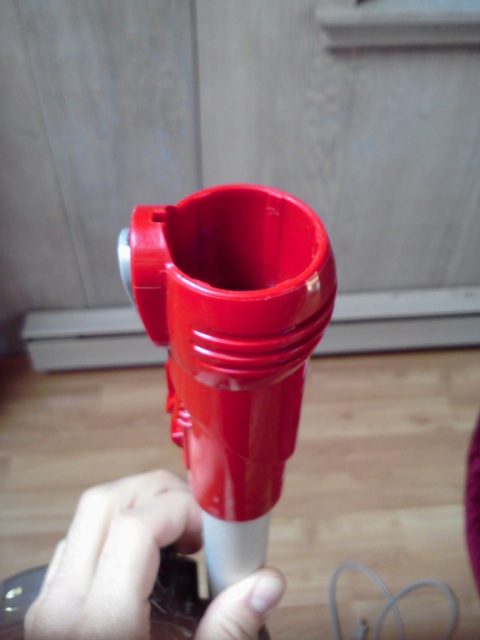
One of these kids is not like the other. You can toss all of your existing 1¼" attachments out—they’re useless with the Dyson.
Dyson vacuums use proprietary connections for all attachments. Now before you go foolishly hoping that other attachments may work by jamming them into the same holes, think again. They won’t. What’s even more frustrating is that Dyson sells a “universal fit adapter,” but only in the UK. If you live Stateside, you’re out of luck.
Dyson says “yes” to promotional propaganda
Accompanying the vacuum is an Apple-style pamphlet telling you how great James Dyson is and how lucky you are to have spent hundreds of dollars on his ill-conceived products. It’s insulting and smacks of narcissism.
James Dyson: obsessed with balls. Apparently ¾ of his worthwhile early designs involved taking normal things and slapping one or more balls on them. The DC25 is no different.

Final thoughts
After fifteen minutes of use, it became painfully obvious to us that no one at Dyson had bothered to test this product in an actual cleaning scenario or compare it to competing products. If they did, they would have quickly discovered the above shortcomings and perhaps corrected them.
With over 5,100 iterations, one would think someone would have field tested this product. But I guess it’s easier to spend millions of dollars marketing a gimmick than meaningfully address issues with actual use.

The vacuum is functional. It sucks well. With some minimal bargain hunting, you can probably find the DC25 (or newer iterations) for around $350. But even then, it lacks the type of quality and attention to detail that should be present at that price. When you purchase a Dyson vacuum, you’re effectively paying a hefty premium to be a beta tester for a very slow learner who is apparently obsessed with balls.
But hey, that’s just one guy’s opinion....


Seriously, your an idiot and must have some sort of OCD
ReplyDelete